Friday, 23 March 2018

Camping & Caravan Show

Money was mostly wasted going to the annual West Australian State Camping and Caravan Show.  UK readers will know of the Birmingham Camping and Caravan Show held at the NIA.  for those who have visited the UK show imagine going to the toilets in the north west corner.  That’s about the size of the West Australian Show.  Well I might be slightly exaggerating, but it’s small beer compared to the NIA.

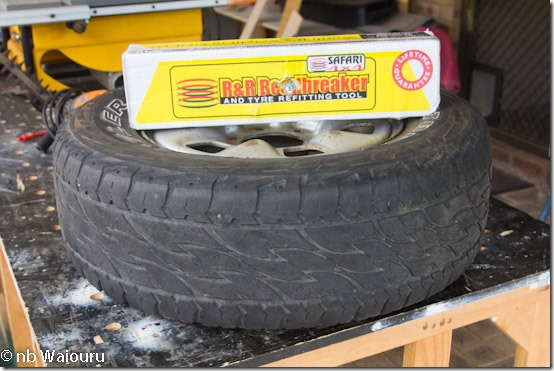
I wanted to look at camper trailers managing to inspect two potentially suitable trailers.  One I’d already seen an the salesman at the other wasn’t particularly interested.  However I did manage to purchase an R&R Beadbreaker with a show discount of 5%.
IMG_2272

Ordinarily, when you get a flat tyre you replace it with the spare and take the flat to the garage for repair.  However when you’re in the middle of nowhere and all on your own, you need to do the repair yourself.  Swinging tyre levers on a heavy duty large 4x4 tyres is hard work and actually proved too difficult for a 75 year old German migrant, so he invented the R&R Beadbreaker to take the majority of the physical effort out of the task.

He actually invented the tool to put the tyre back on the rim. However it was quickly modified to enable it to be used to remove the tyre

IMG_2273IMG_2274IMG_2275IMG_2277IMG_2278

I used this tyre because the tread has almost gone and it had a steel screw through the wall.  The shinny tip of the screw can be seen in this next photo.

IMG_2279

Now I need to teach myself how to replace the tyre on the rim.  Several rehearsals will be required before I’m proficient.

There was a financial win when we purchased a folding table from Aldi for $29.95.  They were being sold at the show for $55.

IMG_2271

Postman Gary appeared today with two small packages.  The first was an orange HiViz vest.

IMG_2280

When travelling lonely outback tracks you are required to fly an orange HiViz flag.  The shops sell them for almost $100.  My HiViz vest from China cost $3.32.  Jan is going to pull out her sewing machine and convert it into a flag.  I’ve already converted an old fishing rod into the aerial.

Gary also delivered the replacement part for the Samsung tablet.

IMG_2282

The usb charging port in the tablet has failed and after an online search I was able to purchase a replacement from China for $12.

On a more general note, our retirement fund (mostly shares) has taken a hit.  Thank you Donald Trump!  This guy is starting to worry me.  When you start surrounding yourself will “Yes” people and think your infallible, you can make a serious mistake.  Ask Hitler, Saddam Hussein or Muammar Gaddafi.

I was also interested in the latest Brexit announcement.  It appears the interim agreement mostly gives both sides another two years of negotiating.  This gets the EU out of a financial crisis, because their next budget forecast is 2020 and if the UK had exited in 2019 the EU would have a massive hole in their budget.  What did the UK gain?  It appears Liam Fox has to get his skates on and have a significant number of free trade agreements settled within the next two years, because that’s the only way I can see the UK having any strength during the final negotiations.  Interesting times!

Meanwhile the Australian weather has gone crazy.  Two major cyclones up north.  Two large bushfires in the south east with more than a hundred homes destroyed and flooding in the east.

Sunday, 18 March 2018

The battery project

Readers you will probably recall me writing about the SkyRC iMax B6 battery conditioner purchased from China.  I decided to run a trial with it attempting to restore an old and dead NiMH electric drill battery.  When I started the trial the battery actual voltage was 3.7 whilst the original specifications stated 12V.  During the first cycle I managed to recharge the battery to 10.8V which led me to suspect there was one defective cell in the battery pack.

The iMax has now cycled the battery charge/discharge four times and the new actual maximum voltage is back to 12V.  I now need to confirm the actual capacity.  At new the battery had 3Ah at 12V, which means the capacity was 2500mA  (3÷12).  Obviously I can’t discharge the battery to zero.  20% of the total capacity is an approximate figure.  Therefore the iMax should have added 2000mA to the battery when it’s fully charged.  The iMax can measure this.


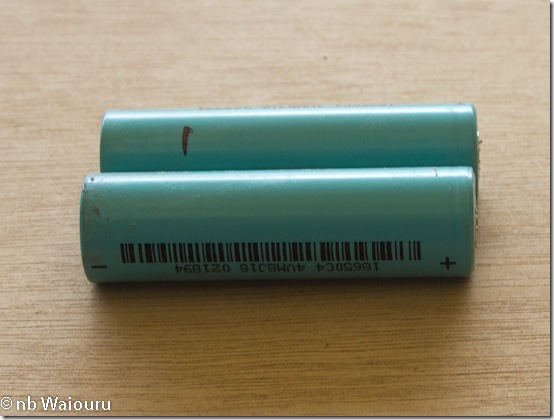
Of course all of this is just an experiment and I now need to start thinking about checking the condition of the six lithium 18650 cells recovered from the netbook battery.  I’ve already used the multi-meter to check the voltage.  Three are at 1.92V and the remainder 1.72V.  The voltage of a fully charged 18650 cell is just under 4V (say 3.7V).  There are several advantages of using lithium over lead-acid or NiMH batteries. 

  • High specific energy and high load capabilities with Power Cells
  • Long cycle and extend shelf-life; maintenance-free
  • High capacity, low internal resistance
  • Reasonably short charge times
  • Low self-discharge

The following graph from the Battery University website shows their discharge characteristics

lithium

As you can see the voltage drop is minimal (3.7 to 3.5) until the battery reaches 20% discharged when it starts to rapidly fall.  This point is known as the “knee” because the shape looks similar to the position of a seated persons leg.  The horizontal portion of the line being the thigh. 

Attempting to re-charge a cell that has gone past the ‘knee’ is complex and the objective is to avoid that occurring.  However not all cells discharge and recharge at the same rate.  This means when the lithium cells are connected together to create a battery they must be ‘balanced charged’.  Effectively this means the lithium cells require two types of charging connection.  A main charge to the pos (+) and neg (-) battery terminals and a balance change to individual cells.

This next diagram shows three cells connected in series to produce 11.1V (3.7x3)  There is a main pos and neg connection between the cells and separate minor connections (red, green,  blue, black) for the balance charging to occur.

Untitled-1

The iMax B6 charger has the ability to simultaneously do both the main and balance charging.  However I want to use it for it’s testing and cell recovery functionality rather than having it tied up charging lithium batteries.

My intention is to rebuild my old NiMH drill batteries by replacing the NiMH cells with lithium 18650 cells.  The NiMH battery charger only has a pos and neg 12V connection which means it can’t balance the lithium cells.  It’s at this point I should explain how the lithium cells will be connected.

Connecting three cells in series (+-+-+-) increases the voltage.  This is described as 3S.  If there were four batteries it would be 4S, etc.  In this case my voltage would be a minimum of 11.1V

IMG_2264

When the cells are connected pos to pos and neg to neg they are in parallel.  In the photo below this would be described as 1P.  When in parallel the voltage doesn’t increase but the current (amps) does.

IMG_2265

With only six cells I plan to connect my cells 3S2P

IMG_2266

I would prefer to have eight cells and connect them 4S2P raising the voltage to 14.8V.  That would put the drill on steroids! Smile

To over come the charging problem I have purchased a small 3S balancing charger.  The original battery charger will provide the main 12V charge and this little charger will fit inside the battery case.

IMG_2267

It will be wired the same as the diagram above.  The board was purchased from China at a cost of $1.32.

By doing this I can use any 12V charger to recharge the drill battery and free up the iMax to do the more sophisticated battery conditioning and recovery.

Friday, 16 March 2018

LED Project Completed

Today was cool enough to work outside on the Isuzu.  I’d made up a lead for the LED and then tested the LED actually illuminated using my new 12V power supply (the pc power supply). 

After looking at the dash I decided to fit it on the air conditioning control panel.  It will be high enough to be obvious, but not so high as to be a distraction if driving in 4x4 at night (not that I plan to do that)

The LED specifications stated it had a 5mm barrel but I discovered it actually required a 6mm hole in the panel.  I secured the fitting with a small plastic cable tie and some glue.

IMG_2268

All the wiring connections were then made using crimp connectors followed by a second test to ensure the LED illuminated.

IMG_2269

The LED doesn’t illuminate when the Isuzu is in two wheel drive.

Turn the knob to 4WD and we have light

IMG_2270

Thursday, 15 March 2018

Sad Face

I’ve been wearing my sad face for the last two days.  One of the hard disk drives in the media server died without warning.  You might recall all the disk drives are software connected together to create one large disk with built in redundancy.  This is supposed to mean your data doesn’t get lost if one disk fails.  Well that didn’t happen…. Primarily because I omitted to configure the notification part of the system.  The consequence of this omission is the failed drive has to be replaced and I also have to rebuild the system after losing all the data.

On a more positive note today Postman Pat delivered two items I’d ordered from China.  The first is a large syringe and the second is a special battery charger/conditioner.

IMG_2258

Our 4x4 is likely to be the last vehicle we will own and I therefore want to do everything reasonably possible to ensure it has a long life.  These days engineering has become so precise vehicles start to develop problems shortly after the warranty period has expired.  The Isuzu has a 5 year warranty and my objective it to ensure that period is extended.  My plan is to remove 70ml of oil from the gearbox, transfer case, front and rear differentials.  This will be replaced with 70ml of Nulon G70.  The G70 contains Teflon.  Yes, the same stuff used to coat frying pans making them non-stick.  The idea is the Teflon in the G70 will adhere to the moving parts in the various gearboxes and differentials thereby reducing wear and extending life.  The syringe seemed the best way to complete this operation.

The battery charger/conditioner is a SkyRC iMax B6.  It’s a sophisticated Balance Charger/Discharger for Lithium, Nickel Metal Hydroxide and Lead batteries.  My plan is to use it to assist me in recovering capacity of used and ‘dead’ batteries.

The first step in this process was to connect the iMax to the computer power supply which I’ve previously mentioned.

IMG_2259

With the pc power supply connected I was able to connect a ‘dead’ NiMH battery from my Panasonic drill.  The battery specifications are 12 Volt 3 amp but in it’s dead state the voltage is 3.7V with no amps. 

After connecting the battery to the iMax it started to recharge the battery, something the drill charger wouldn’t do.

ps1

The battery voltage slowly rose until it reached 10.8 Volts where the iMax stopped.  I then set the iMax to cycle the battery flat and then recharge three times.  Each cell has a voltage of 1.2V and the battery capacity is 12V.  So the battery is 1.2V short of being fully charged.  This suggests to me that one of the cells in the battery has failed.  Hopefully the charge/discharge cycles will result in the recovery of the defective cell.  What the iMax will attempt to do is remove the “crud” that has built up on the surface of the surfaces in the cells of the battery thereby recovering lost capacity.  This is a similar process to the ‘Equalizing Charge’ on lead acid batteries.  The actual process and the characteristics of the iMax are more sophisticated than I’ve described, but it will do for now.

Monday, 12 March 2018

Water Usage

We’ve received our latest water bill for our Adelaide house which has been vacant since June 2017.  At that time we had the water turned off at the meter rather than paying the huge sum to to physically disconnect the water pipe.  Today’s water bill for the previous quarter was $239.23.  How much water had we used…. zero!   The bill consists entirely of the supply charge.  One might wonder why the electricity company only imposes a supply charge when the home actually consumes electricity, yet the water company has a supply charge irrespective of usage.  The only difference I see is the customer has a choice of electricity retailers whilst the water company has a monopoly!

And while I’m having a whinge…… Our mail filter is working overtime removing all the spam heading for our In Box.  the vast majority of it is from India and I assume some company we have corresponded with has sold on our address (along with thousands of other addresses).  Fortunately the filter is 99.99% accurate.

Meanwhile, Jan is receiving regular unsolicited calls from India (well they speak English with an Indian accent).  They obviously have her name (how?) and promptly launch into their sales script.  Jan just places her mobile face down on the glass table top beside her chair.  Apparently this creates a high pitches feedback squeal.

A small amount of progress has been made on my 4x4 LED project.  We visited Jaycars yesterday where I bought a small blue LED and some resistors.  The resistor was connected to the positive terminal of the LED and then covered with red heat shrink.

IMG_2257

I now need to find a suitable location on the dash to drill the 5mm hole and mount the LED.  Too hot today!

Saturday, 10 March 2018

Hot Rubber Smell

When we returned home yesterday Jan immediately commented on a smell of hot rubber coming from the rear of the Isuzu 4x4.  My immediate thought was I’d run some cabling over the exhaust and then promptly discarded the idea as something I’d never do.

Eventually I realised the Isuzu was in four wheel drive.  It’s something you shouldn’t do if driving on bitumen.  Somehow the selector knob in the cabin had been knocked from 2WD to 4WD.  The small 4WD icon on the dash is the same colour as the numerous other icons and I hadn’t noticed it.  Moreover this is the second time the selector know as accidentally engaged 4WD.

I’ve decided to fit my own 4WD warning light in a prominent place on the dash.  It only needs to illuminate in 4 High Range as 4 Low Range is rather obvious.

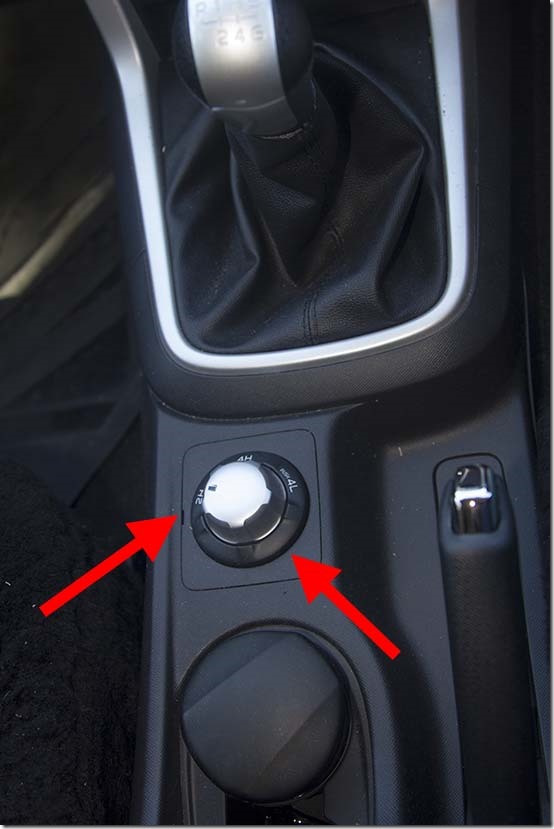
The first step was to remove the Selector Knob.  This came out rather easily when I inserted a small flat tipped screwdriver into the recess on the passenger side (left arrow).

4wd

There was a green plug under the knob.  I used the multi-meter (thank you Maplin) to establish which wire was ‘live’ when 4H was selected.   It was the White wire with the Black stripe.

4wd1

I stripped some of the insulation off this wire and then soldered a length of spare cable to it.  This will be the positive cable to the LED.  The bare joint was wrapped in insulation tape and the selector knob re-assembled. 

The next step will be to visit Jaycars (Maplin equivalent) and buy a suitable LED.  My preference is for a bright Blue LED.  I don’t plan on driving in 4x4 when it’s dark so the bright LED isn’t going to affect any potential night vision.

The other thing I’ve been working on is the lithium battery project.  The plan to recover lithium cells from old laptop batteries will mean some of the cells will be “dead”.  I therefore need to test every cell to firstly identify the dead cells (which will be discarded) and then establish the capacity (in milliamps) of the remainder.  This means each cell will need to be charged; then discharged and finally; recharged.  I’ve purchased a SkyRC iMax B6 charger from eBay which is capable of doing the above.  However it can probably only test an average of one cell daily.  This isn’t a problem if I only want to make lithium batteries for electric drills as they only have 6-9 cells.  however if I decided to complete my major project; a lithium battery to power the house then that will require around 17,000 cells.  I’ll be long dead before that project is completed Smile

But wait……  The SkyRC iMax charger requires an external 12V DC power supply.  Moreover there are cheap lithium cell charger and dischargers available from China.  These require an external 5V DC power supply. 

You may recall I’m reluctant to throw things away (yes I’m a hoarder).  I’ve been trowing away old desktop pc cases; but not before I’ve removed the internal components; including the power supply.

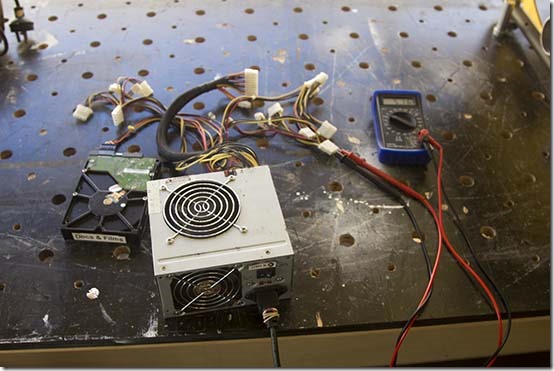
Well the power supply has an input of 240V AC and dual outputs of 12V and 5V DC.  I’ve found my power supply for the SkyRC and the cheap Chinese chargers and dischargers.

ps

There are two things to note here.

1.  The power supply won’t work if it is connected to the 240V supply but not connected to a computer motherboard.  I eventually worked out I could get around this problem by connecting the GREEN wire on the main power plug to the motherboard to any BLACK wire.  This tricks the power supply into working.

2.  The second thing is the power supply was reluctant to supply any 12V or 5V power without a ‘load’.  Usually this would come from the motherboard but as I’m not using one I connected a ‘dead’ hard drive to the power supply.  The hard drive provides a ‘load’ and tricks the power supply into providing the DC voltage.

ps2

The RED wire produces 5V DC

ps1

And the YELLOW wire produces 12V DC.

A 18650 lithium cell should be charged or discharged at 5V and 1amp.  The computer power supply is rated at 430 Watts (Watts = Volts x amps) so a VERY rough calculation suggests the power supply should be able to simultaneously charge or discharge 86 cells.  I’m thinking of simultaneously charging 20 cells and discharging 5 so there shouldn’t be a problem.

Wednesday, 7 March 2018

Another One Completed

Postman Pat delivered the Chinese ‘knock off’ copies of the 50A Anderson Plugs I’d ordered.  There are people who will caution you against purchasing these Chinese replicas warning they may melt or catch fire.  Of course most of these warning come from the sellers of the original (expensive) plugs.  Our imitation Anderson Plugs will never carry a 50A load so that risk is almost non existent. 

I soldered one of the plus onto the end of my fridge adapter and then connected it to the Anderson Plug previously fitted into the back of the 4x4.

IMG_2248

But not before using the multi-meter to confirm I had the polarity correct.  Because the wiring for the fridge goes via the Voltage Sensitive Relay (VSR) I needed to start the engine to raise the alternator voltage above 12.8V.  This ensured the VSR activated.  The LED on the Engel fridge plug illuminated. Smile

IMG_2249

Then I pulled out the fridge slide to check the fridge was operating.

IMG_2250

Now we can go food shopping without having to hurry home before the frozen food defrost in the heat.

Tuesday, 6 March 2018

Beast from the East

After days of watching the ‘Beast from the East’ on the evening news we’re starting to think we may be in the wrong country.  It’s been in the high 30’s every day this week and not forecast to drop to 29 until next week.  I think we’re suffering from the ‘Swine from the South’ or the Nasty from the North’. 

Whilst out on my evening walk last night (I returned wringing wet with sweat) the street lights went out.  Then I noticed all the houses were in darkness.  On returning to the house Jan informed me a vehicle had crashed into a light pole on adjacent Hepburn road plunging the suburb into darkness.  It’s now the following afternoon and electricity has yet to be restored.  At least we have the boat generator which has the ability to keep the fridge and freezer running.  However it doesn’t have sufficient capacity to run the air-conditioning. 

When it’s cold you can add more layers.  But when the reverse occurs there are only so many layers you can remove.  Although this does have an advantage with the door knockers flee in horror!

With nothing better to do we shuffled the furniture around.  The latest sewing cabinet repairs worked which meant we could move it back into storage.  The spare bed was moved to the 3rd bedroom, which then left space in the front room for the sofa, dining table and oval tables.

IMG_2247

Note the curtains are drawn in an effort to keep out some of the heat.

I’ve also made a lead for the 4x4 fridge.  The socket in the vehicle is a 50amp Anderson Plug but the Engel fridge has a fused cigarette style plug.  I didn’t want to cut the cigarette plug off the fridge lead because you never know when you might need to convert it back.  So I’ve made a short adaptor lead from some ‘bits’ I had lying around.

This female cigarette socket has been in my “I’ll need that one day” box for a couple of decades.

IMG_2234

I used my old soldering iron to remove the original cable and replace the wiring with something more substantial.  The soldering iron is more than 40 years old.  I ‘found’ it in a creek behind the house were were living in at the time.  All it needed was a replacement cord.

IMG_2235

The adaptor just needs the Anderson Plug on the other end.

IMG_2237

Of course that has been ordered from China (cheap… as you would expect).

You might recall the Samsung Tablet had a replacement battery fitted.  Well yesterday the tablet was flat; despite being on charge for 10 hours.  MAJOR WORRY!  More research suggested the tablet micro usb plug may have failed.  It can be replaced, but a replacement usb socket from the USA cost $43.  eBay was my friend and I found an alternative supplier in China for $4.32.  Delivery was free but it would take 2 months.  Express delivery can be arranged for $153.  I’ve opted to wait for the junk to arrive in port! Smile

Sunday, 4 March 2018

Failure

Well that was a failed effort!  The attempt to remove the warp in the base of the sewing cabinet didn’t work.  After closely examining my first effort (wearing my specs this time) I realised the rectangular length of hardwood I’d glued in place to straighten out the particle board base was riding on top of a metal mounting plate for the castor.  This had the effect of raising one end of the hardwood support by 3mm. 

I knocked out the hardwood with a hammer and changed my method.  This time the length of hardwood doesn’t ride over the mounting plate and I’ve also cut a small triangular piece of hardwood which has been glued into the corner.

IMG_2245

I’m hoping planning on this being more successful.

Yesterday we had a visit from local blog reader Ken and his lovely wife, Elaine. 

IMG_2243

We spent a very pleasant afternoon conversing about all things narrowboat whilst I burned the sausages on the BBQ.  You might have noticed Elaine is holding what looks to be a Pearsons Guide.  Yes, they have booked their 2018 canal holiday and plan to spend three weeks cruising the Cheshire Ring during late August – early September.  So if you happen to see a Black Prince boat with a crew that looks slightly lost, then blame me for giving poor directions!  Oh…. we did talk toilets!

As for us…… We will be visiting more ‘open homes’ today in our continuing search for somewhere permanent to live.

Saturday, 3 March 2018

Sewing Table

A partial repair on Jan’s sewing table today.  One corner of the base has warped with the heat whilst in the storage container.  The entire cabinet is made from veneered particle board and my plan was to straighten the warped section and then glue a rectangular length of hardwood behind to hold the straightened section in place.

The first step was to clamp a length of hardwood across the warped area and establish how badly it was twisted.

s_table1

I’ve drawn a red line on the photo to show where ‘level’ is.

The next step was to add some weight to the end of the clamped length of hardwood and twist the warped base back level.  The kitchen table chair and a book proved sufficient.

s_table2

With the warp now removed I glued and clamped the length of hardwood on the inside of the join between the straightened base and side of the cabinet.

s_table3

It will stay this way for 48 hours and then {hopefully} the timber base will be straight.  The cabinet door panel and front to one of the drawers also need replacing.  but I need to find a timber supplier before undertaking that task.

Meanwhile, we are getting as steady stream of vehicles passing our letterbox.  The local council is having it’s bi-annual kerbside hard rubbish collection next week and our neighbours have been placing their old TV’s, fridges, washing machines, unwanted furniture, bikes, etc etc out on the kerb for collection.  All of this encourages the ‘scabs’ to cruise the neighbourhood where they rummage through the “rubbish” looking for “treasure”.  I usually doesn’t worry me but many of them do tend to leave the rubbish scattered when they depart. Sad smile

Thursday, 1 March 2018

More ideas

We went out shopping today and whilst Jan was successful my efforts to buy a cheap aerosol of compressed air to clean the laptop fan proved fruitless.  Consequentially the laptop repair project is on hold. 

However I decided to start on my Lithium battery project.  The idea is to make a Lithium battery bank with enough storage capacity to power a house.  We would have 5kW of solar panels on the roof which would charge the battery bank when it’s dark.  Perth receives a large amount of sunlight which I believe makes the idea viable.  Before launching myself into this major project it seemed prudent to attempt something smaller and I’ve decided to repower the batteries of my old Panasonic portable drill.

IMG_2238

It’s more than a decade old and had replacement batteries before we left for the UK in 2011.  Since returning I’ve discovered these batteries are also now dead.  The battery pack does provide information on battery capacity which is helpful when calculating the required number of replacement Lithium cells.

NMHI

I can probably increase the battery capacity slightly and give the drill more oomph!

The first problem was disassembling the battery pack.  Fortunately Lidl came to my aid.  We were walking through Lidl when I noticed a drill set and thought “that might come in handy” before slipping it into the shopping trolley when Jan was looking in the opposite direction.

IMG_2233

Relief…… one of the bits fitted the screw heads.

With the battery pack disassembled it was possible to see the makeup of the Ni-MH cells.

IMG_2229

All of this gets discarded except for the black plastic cap which contains the battery terminals.

My source for Lithium cells is going to be the battery from our old Asus eee netbook.  We haven’t used it since 2009 when we took it on our UK holiday.  The netbook will work from the main supply without the battery and I’m thinking of using it (the Netbook) to monitor the planned house battery bank.

eee

I guessed there were between 6 and 9 cells in the battery.

IMG_2230

IMG_2231

Lithium batteries require a Battery Management System (bms) to be safety charged and individual cells are directly connected to the bms.  You can see the Netbook battery bms in the above photo.  I will have to discard it as it’s too long to fit into the drill battery pack.

IMG_2232

I have six batteries, which should be sufficient to make one battery pack.  I’ll also need a replacement bms and have already purchased one from China.  This will fit inside the battery pack.

bms

This is where the project now pauses whilst I wait for the bms to be delivered.  I also need to test the Lithium cells to ensure all six are OK.

Once I’ve made two replacement Lithium battery packs for the drill I think I’ll make a larger capacity Lithium battery for mum’s old mobility scooter.  This currently has a 12V lead acid battery which is also starting to get tired.